Skip to content
Search
Menu

Bookings here go through Viator, who pay us a commission. You are charged the same either way, and the commission had no say in this list.

Landmark

Pilgrim Monument

Last updated

A 252-foot granite campanile modelled on a Tuscan town hall, climbed by ramps, with the best view of Cape Cod's geography from anywhere.

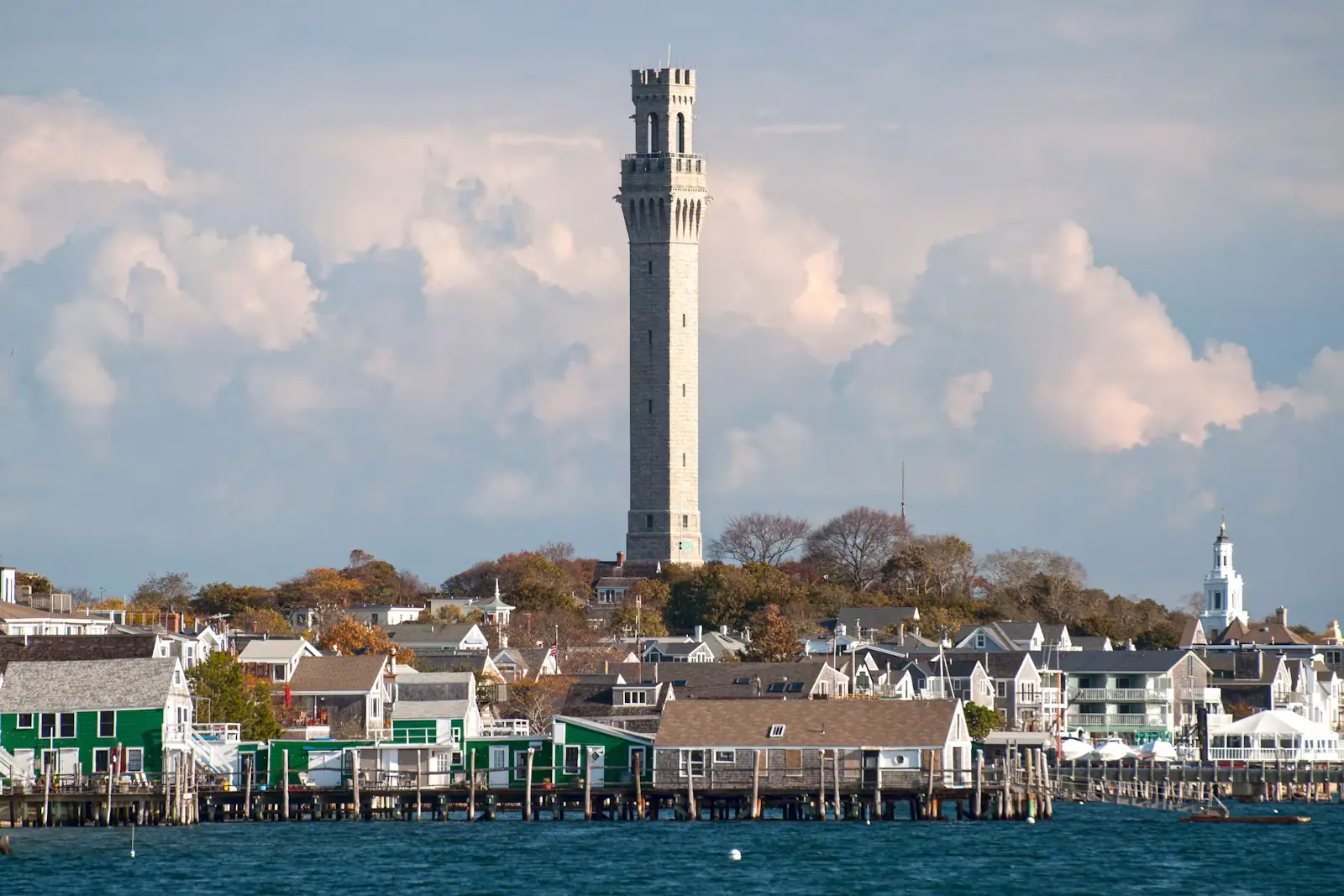
There is a medieval Italian bell tower on a hill in Provincetown, and the explanation is stranger than the building. When the town held a competition in 1906 for a monument to the Mayflower's arrival, the winning design by Willard T. Sears was based on the Torre del Mangia, the fourteenth-century campanile on the town hall in Siena. Critics at the time pointed out, reasonably, that this had nothing whatever to do with the Pilgrims. It was built anyway, and it has been the thing you see first from the ferry ever since.

The numbers are worth having. It stands 252 feet 7½ inches, which makes it the tallest all-granite structure in the United States, and because it sits on High Pole Hill the top is around 350 feet above sea level. President Theodore Roosevelt laid the cornerstone on 20 August 1907 and President William Taft dedicated it on 5 August 1910.

What it commemorates is often misremembered. The Mayflower's first landfall in the New World was here, not at Plymouth. The ship anchored in Provincetown Harbor in November 1620, the Mayflower Compact was signed aboard in this harbour, and the men spent five weeks exploring the Cape before deciding the place had no reliable fresh water and moving across the bay. Provincetown has been making the point ever since, at considerable expense in granite.

The climb is the surprise. Rather than a spiral staircase, the interior is a sequence of gently ramped ascents with occasional short flights of steps, which makes it a far easier proposition than its height suggests. Children who could not manage a lighthouse stair manage this one.

The Provincetown Museum at the base is included with the ticket.

Getting there and parking

The monument stands on High Pole Hill directly above the town centre. On foot from MacMillan Pier it is about ten minutes, flat along Commercial Street and then a short steep climb from Bradford Street up to the grounds.

There is a small car park at the top reached by a narrow, steep approach; it fills in season and is not a realistic plan on an August afternoon. Parking anywhere in Provincetown in summer is difficult and expensive, which is the general argument for arriving by ferry.

From the Boston or Plymouth fast ferry, the tower is visible from the boat and the walk from the pier is straightforward.

Check the monument's current information on the accessible approach from Bradford Street before travelling if a steep walk is a problem.

What you see from the top, and why it matters

This is the best money spent on Cape Cod for anyone trying to understand the place, and it works best on the first day of a trip rather than the last.

From the observation level the whole hook is laid out. Look south-east and the Cape runs away from you in a long curve — Truro, Wellfleet, Eastham, and the outer beaches visible as a thin white line against the Atlantic. Look west and you have Cape Cod Bay, with the Province Lands dunes in between and Long Point curling round the harbour like a closing hand. On a clear day you can pick out the Boston skyline more than forty miles north across the bay, and the tower on the Blue Hills behind it.

That single view explains what a map does not: how narrow the Outer Cape is, why there are three different coasts, why the harbour is where it is, and why everything you have driven past for two hours is sand.

  • Go on a clear day. Haze in high summer kills the distance; after a cold front is ideal.
  • Morning light favours the view down the Cape, evening light the bay.
  • It is windy up there. Always. Hold onto hats and phones.
  • The viewing level is enclosed with openings rather than open-air, which helps in a gale and frustrates photographers.

Ramps, not stairs

The interior climb is the thing people are most wrong about before they arrive. It is not a lighthouse spiral. The tower is ascended by a series of long, gently graded ramps with short flights of steps between them, and the effect is a steady walk rather than a stair workout.

Most reasonably mobile adults do it in ten to fifteen minutes at an unhurried pace, and plenty of people well into their eighties climb it. There are landings to stop at, each with an opening in the granite and a different view, so it is not a blind slog.

That said, it is 252 feet with no lift. Anyone with a serious heart or breathing condition should treat it as a genuine climb, and small children need supervision on the ramps rather than freedom.

Come in the first hour after opening or the last two before closing to avoid queueing on the ramps, which is the only way this climb becomes unpleasant — a August midday backlog on a narrow ramp in granite is warm and slow.

Opening dates, hours and ticket prices are set seasonally and the monument closes for part of the winter. Check the Pilgrim Monument and Provincetown Museum's own schedule before you go, and check the current state of the accessible approach from Bradford Street if that matters to you, because the hilltop is reached by a steep path.
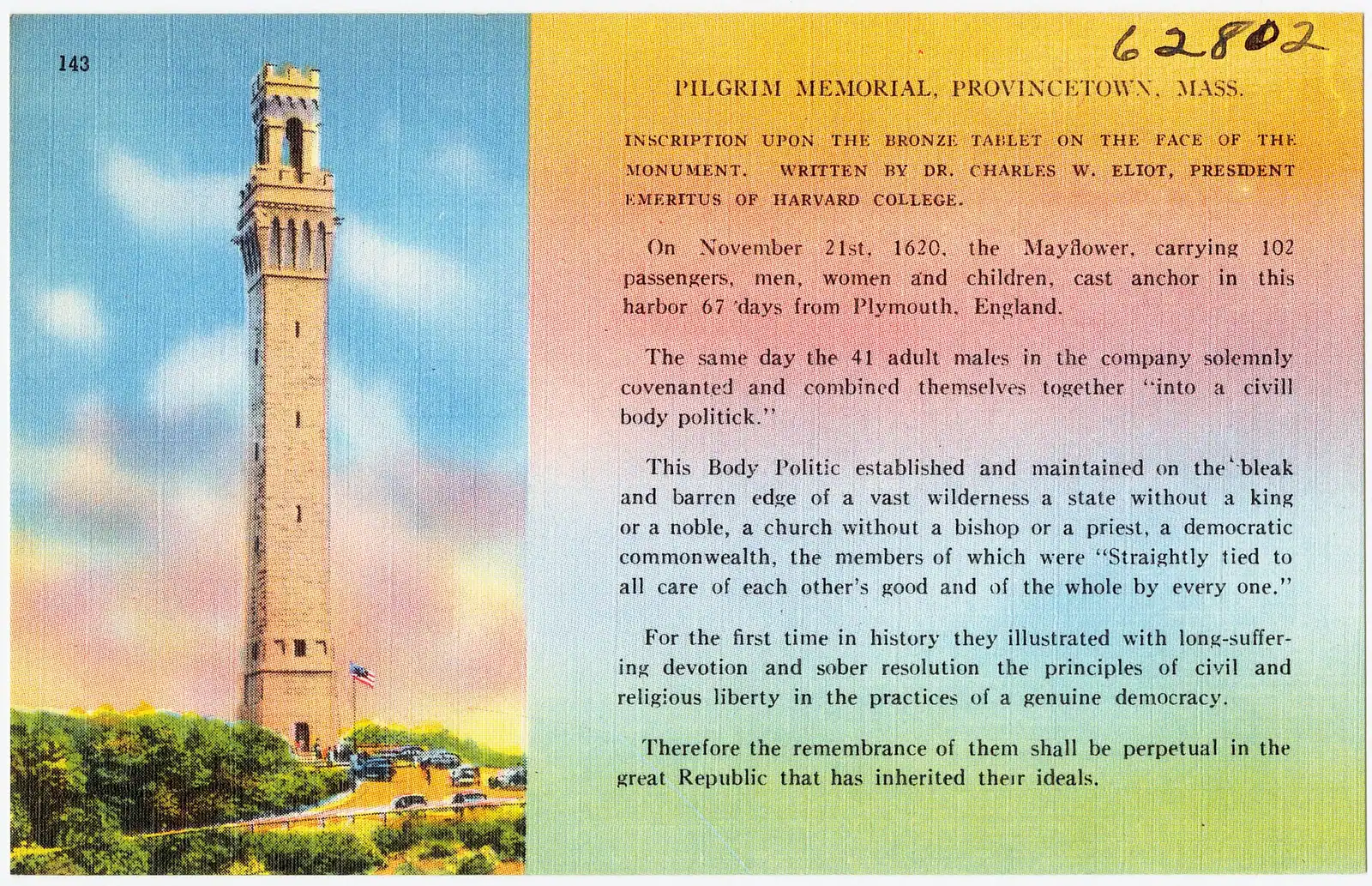
The Provincetown Museum at the base

The museum is included in the ticket and most people walk through it too fast on the way out, tired from the climb. Go in first.

It carries the town rather than only the Pilgrims: the Mayflower's five weeks in the harbour and the signing of the Compact, the Portuguese fishing community that built modern Provincetown, the wreck of the pirate ship Whydah off Wellfleet, the arctic expeditions of Donald MacMillan — who was born in Provincetown and after whom the town pier is named — and the art colony that made the place famous. A relief by Cyrus Dallin showing the signing of the Mayflower Compact is set into the monument itself.

What is worth sitting with is the fishing material. Provincetown was one of the most productive fishing ports in Massachusetts, the Azorean community that crewed the fleet is still here, and the boats you can see from the top of the tower are the same industry in a much reduced form.

The grounds are pleasant and free to walk, with a view over the town's roofs that is nearly as good as the one from the top and costs nothing.

From late November into January the monument is strung with lights from its top to its base and lit at night, which is the one time of year Provincetown's off-season has a crowd.

Getting up the hill

The monument sits on High Pole Hill above the town, and getting up there is the part that catches people out.

There is a small car park at the top, reached by a steep and narrow approach, and it fills quickly in season. Most visitors walk up from Bradford Street, which is a short but genuinely steep climb on foot before you have climbed anything at all. Factor that in if the group includes anyone who finds hills hard — you can arrive at the ticket desk already tired.

The town has worked on improving the accessible approach from Bradford Street in recent years. Arrangements have changed, so check the monument's current access information rather than relying on an older description, including whether any assisted approach is running on the day you visit.

There is no parking problem worth solving if you arrive by ferry: the walk from MacMillan Pier takes about ten minutes, most of it flat along Commercial Street, with the hill at the end.

Allow an hour and a half for tower and museum together, two if you read the exhibits properly.

Near The Monument

Straight-line distances, so allow more on the road — the island is long and has one main parkway.

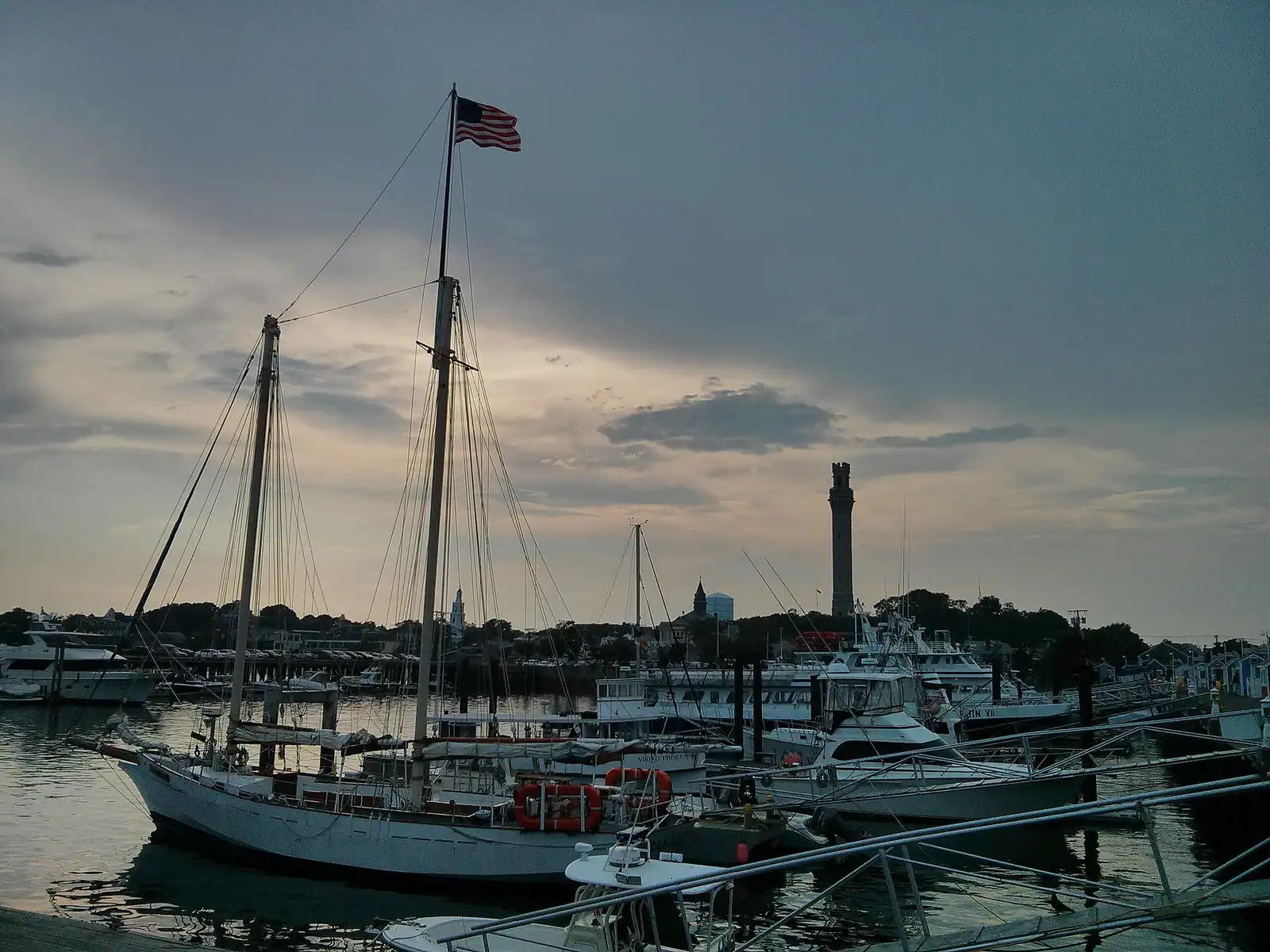
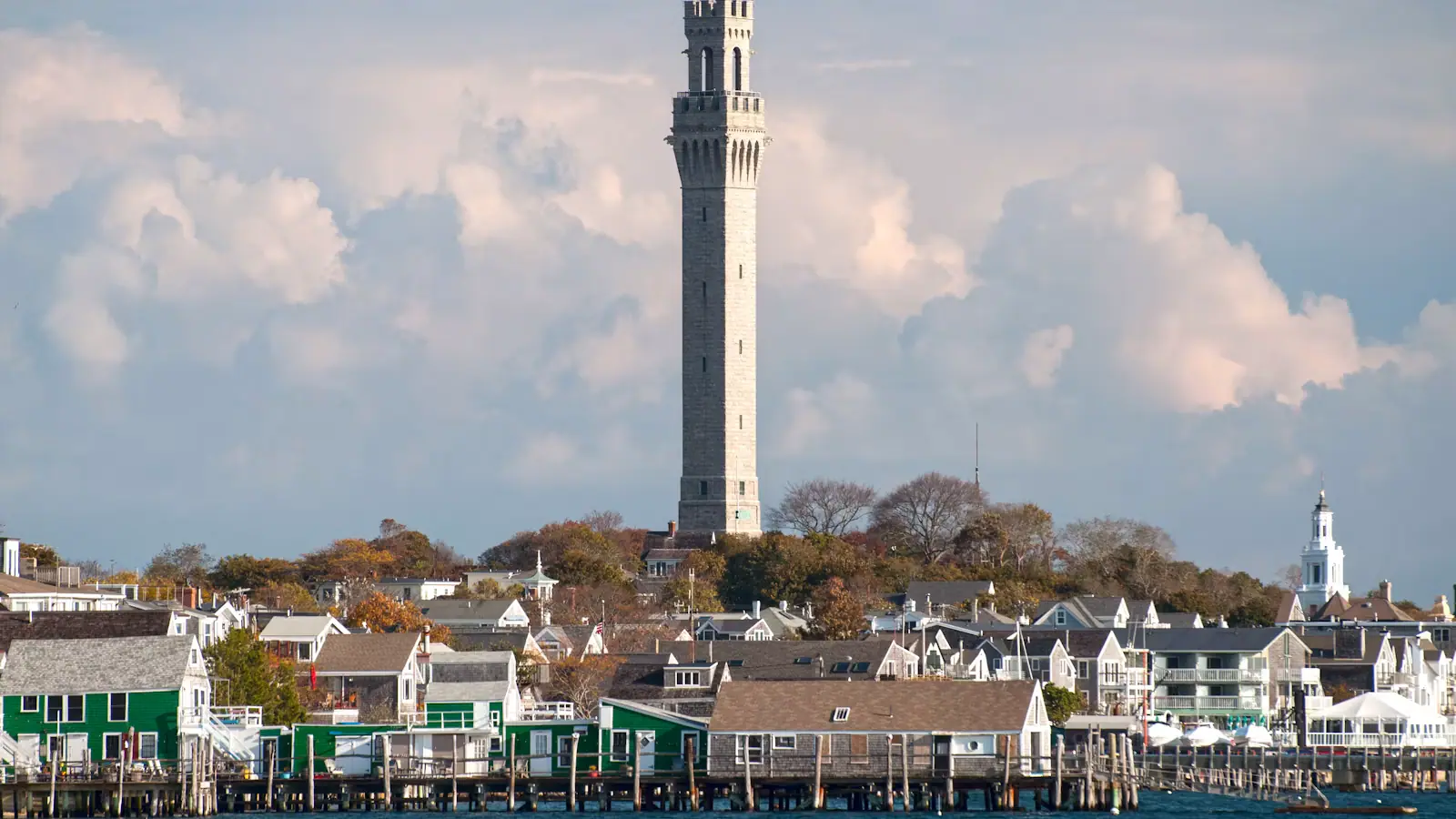
  • The granite tower of the Pilgrim Monument rising above Provincetown's rooftops beside the harbour

    Neighbourhood

    Free

    Provincetown

    Three thousand people in winter and sixty thousand in August: a fishing port, an art colony since the 1890s, and unlike anywhere else.

    4–12 hoursFree to visit. Parking, ferries, the monument and tours are charged separately.310 ft away

  • Fishing and excursion boats tied along a pier in Provincetown Harbor with the town behind them

    Marina

    Free

    MacMillan Pier

    One working pier carrying the Boston ferries, fifteen whale-watch boats and a fishing fleet — and the departure point for Stellwagen Bank.

    0.5–4 hoursFree to walk. Whale-watch trips, ferries and parking are charged separately.0.3 mi away

  • Sunset over flat water with two low island profiles on the horizon

    Beach

    Herring Cove Beach

    The only park beach on the bay side: warmer water, no shore break, no staircase, and a sunset that draws a crowd with folding chairs.

    2–5 hoursNational Seashore fee: $25 per vehicle per day, or $15 per person on foot or by bicycle.2.1 mi away

  • Whales surfacing together in open grey water off the Massachusetts coast

    Beach

    Race Point Beach

    The beach at the outside of the fist, facing north into deep water — the one place on the Cape where whales are visible from a towel.

    2–6 hoursNational Seashore fee: $25 per vehicle per day, or $15 per person on foot or by bicycle.3 mi away

The Monument: common questions

How many steps are in the Pilgrim Monument?

Fewer than you would expect, because most of the climb is not steps at all. The interior is a sequence of long, gently graded ramps with short flights of stairs between them, which makes ascending 252 feet a steady walk rather than a stair workout. Most reasonably mobile adults reach the top in ten to fifteen minutes at an easy pace, with landings and openings to stop at on the way. There is no lift, so it is still a genuine climb.

What can you see from the top of the Pilgrim Monument?

The whole hook of Cape Cod. Looking south-east, the peninsula curves away through Truro, Wellfleet and Eastham with the outer beaches as a white line against the Atlantic. Looking west, Cape Cod Bay opens out with the Province Lands dunes and Long Point in the foreground. On a clear day the Boston skyline is visible more than forty miles north across the bay. It is the best single explanation of the Cape's geography available anywhere.

Why does the Pilgrim Monument look Italian?

Because it is. Willard T. Sears won the 1906 design competition with a tower modelled on the Torre del Mangia, the fourteenth-century campanile beside the town hall in Siena. Critics noted at the time that a Tuscan bell tower had no obvious connection to the Mayflower, and they were right. It was built regardless — 252 feet 7½ inches of granite, the tallest all-granite structure in the United States, with its cornerstone laid by Theodore Roosevelt in 1907 and its dedication by William Taft in 1910.

Did the Pilgrims land in Provincetown or Plymouth?

Provincetown first. The Mayflower made its first landfall in the New World here in November 1620, the Mayflower Compact was signed aboard in Provincetown Harbor, and the men spent about five weeks exploring the Cape — including the skirmish at First Encounter Beach in Eastham — before concluding the peninsula lacked reliable fresh water and crossing the bay to Plymouth. The monument exists largely to make that point, which Provincetown has felt strongly about for well over a century.